
Governor Edwards Issues Statewide Stay at Home Order - How Does it Impact Real Estate?
Louisiana REALTORS • March 23, 2020
Patricia B. McMurray, JD and Melissa M. Grand, JD
Baker, Donelson, Bearman, Caldwell & Berkowitz, PC
450 Laurel Street, Chase Tower North, 21st Floor
Baton Rouge, Louisiana 70801
The COVID-19 situation is rapidly evolving. Many state and local governments across the country are issuing orders to either shelter in place or to “stay at home unless essential.” On March 22, 2020, Governor John Bel Edwards issued a statewide Stay at Home Order (the “Order”) effective on March 23, 2020 at 5:00 p.m. through April 13, 2020. Supplemental guidance on essential businesses issued by the Governor’s Office may be found here: https://gov.louisiana.gov/assets/docs/covid/Essential-Infrastructure_fact-sheet.pdf.
We encourage brokers and managers to contact their agents and support staff to determine a plan of action on how best to serve their clients through remote and virtual methods and how to conduct business while also following the Governor’s Order and the CDC’s guidelines on group gatherings.
1. Does the Governor’s Stay at Home Order mean I cannot conduct business?
Short Answer: No. “Real estate” is not a temporarily closed business or “essential activity” under the Order, so this generally means your business is in the category that may remain open under strict conditions.
The Order provides that gatherings of 10 people of more people shall be postponed or cancelled.[2] Further, all individuals within the state of Louisiana are under a general “stay-at-home order” and are directed to stay at home unless performing an “essential activity.”[3] “Real estate” is not an “essential activity” under the Order. “Essential activity” means:
Ø obtaining food, medicine, or similar goods for the individual or a family member; obtaining medical care for the individual or a family member;
Ø going to and from the individual’s workplace to perform essential worker functions;[4]
Ø going to and from a family member’s home;
Ø going to and from an individual’s place of worship; and
Ø engaging in outdoor activity, provided a distance of 6 feet between individuals is maintained and the gathering is limited to 10 people or less.[5]
Additionally, the Order provides that certain nonessential businesses[6] shall be closed to the public and members, but not prohibited from conducting necessary activities such as payroll, cleaning services, maintenance or upkeep as necessary.[7] If an industry sector or occupation is not listed in CISA guidance as “essential” and therefore open, but also not specified in the Order as temporarily closed, then a business falls under Section 5 of the Order and “must reduce operations to continue with minimum contact with members of the public and essential employees, while requiring proper social distancing. Further, the 10-person limitation on gathering size shall apply to such business operations.”[8]
The federal, state, and local governmental response to the coronavirus is rapidly evolving. Continue to monitor the CDC’s website for up-to-date information about the coronavirus' current impact in the United States.
2. Can we still conduct real estate closings?
Short Answer: Real estate closings are not specifically prohibited by the Order. So, it appears that closings can still occur as long as the gathering is limited to less than 10 people and social distancing requirements are maintained.
Although not specifically listed, real estate closings or settlement services may potentially be covered in CISA’s guidance[9] and fall within one of the “essential” work classifications, such as financial services. If so, real estate closings would be permitted to go forward under Section 3 of the Order. If real estate closings are not covered in CISA’s guidance, closings may still be able to go forward under Section 5 of the Order, if the gathering is limited to less than 10 people and social distancing requirements are maintained.
Banks and lenders are classified as “essential” and can remain open. However, other service providers such as title and inspection can open but may not depending on each companies’ decision; if they do open must adhere to requirement that there be no more than 10 individuals as well as social distancing.
To the extent possible consider postponing closings. See Coronavirus Amendment to the Louisiana Residential Agreement to Buy or Sell. The Governor’s directive (see excerpt, below) is for individuals to stay home whenever possible. Further consider impact of and the lack of the availability of other services your clients may need if the transfer of property goes forward such as movers and house cleaners.
3. Can I still hold open houses on listed properties or show houses?
Short Answer: We strongly discourage open houses and encourage you to use virtual means to conduct showings.
Considering the rapid spread of the coronavirus in Louisiana, and the Governor’s directive (see also excerpt, below) for individuals to stay home whenever possible, it is advisable that open houses and showings be postponed or conducted virtually. There is no way to ensure that the gathering can be limited to 10 people and social distancing requirements can be maintained when the general public is invited to a location for an open house. Additionally, in-person showings put you and your clients in risk of being infected with the virus.
As Gov. Edwards explained:
In Louisiana we have taken aggressive measures to mitigate the spread of COVID-19 and flatten the curve; however, this is not enough. As our number of cases continue to grow, I am directing all Louisianans to stay at home unless it is absolutely necessary for you to leave. I am implementing this measure to help prevent you from becoming infected or infecting someone else. People can leave their homes to do essential things like buying groceries or food, pick up medicine or go to work only if their job is essential. If you have to go out, make sure you practice social distancing measures and keep 6 feet between you and the people around you. People are encouraged to go outside and to stay active during this time, as long as they practice social distancing when they are around their neighbors. This order is not something I take lightly, but it is necessary to protect the health, safety and well-being of our people, our communities and our way of life.[10]
4. Can I still proceed with my property management functions?
Short Answer: The Order does not specifically prohibit property management services; however, the impact of the pandemic on lease contracts is uncertain as this time.
The Order requires some businesses to close for now. What ramifications this and other effects of the pandemic may have on specific leases is fact and contract specific.
DISCLAIMER
Information and additional guidance and orders regarding the pandemic are being issued daily. The information is the article was last updated on March 23, 2020 at 9:00 a.m.
These materials are to be used for informational purposes and should not be construed as specific legal advice. These materials are not designed to cover every aspect of a legal situation for every factual circumstance that may arise regarding the subject matter included.
This publication is for reference purposes only and association members or other readers are responsible for contacting their own attorneys or other professional advisors for legal or contract advice. The comments provided herein solely represent the opinions of the authors and is not a guarantee of interpretation of the law or contracts by any court or by the Louisiana Real Estate Commission.
[1] Information and additional guidance and orders regarding the pandemic are being issued daily. The information is the article was last updated on March 23, 2020 at 9:00 a.m.
[2] See Order, Section 2.
[3] See Order, Section 3.
[4] See http://www.cisa.gov/identifying-critical-infrastructure-during-covid-19. Guidance on what worker functions are “essential” is outlined by the U.S. Department of Homeland Security, Cybersecurity & Infrastructure Security Agency (CISA). See http://www.cisa.gov/identifying-critical-infrastructure-during-covid-19 and https://www.cisa.gov/sites/default/files/publications/CISA-Guidance-on-Essential-Critical-Infrastructure-Workers-1-20-508c.pdf. According to CISA guidance, critical infrastructure industries, such as healthcare services, pharmaceutical, and food supply, are essential. See CISA’s website for further explanation on essential critical infrastructure jobs. See also, Governor’s guidance on essential businesses, https://gov.louisiana.gov/assets/docs/covid/Essential-Infrastructure_fact-sheet.pdf.
[5] See Order, Section 3.
[6] Section 4 of the Order lists specific nonessential businesses ordered to be closed to the public and members.
[7] See Order, Section 4.
[8] See Order, Section 5.
[9] See http://www.cisa.gov/identifying-critical-infrastructure-during-covid-19.
[10] See https://gov.louisiana.gov/index.cfm/newsroom/detail/2427 (emphasis added).

Want Your Teen to Own a Home Someday? Start Talking Money Now Teens may not be thinking about mortgage rates or down payments just yet, but the money habits they’re building now can follow them for years. And 88% of teens surveyed by Fannie Mae and Junior Achievement said they want to own a home someday. This week’s Consumer Guide: Talk to Your Teens About Money and Homeownership makes those conversations a little easier, covering everything from credit scores and budgeting to debt, renting versus owning and saving for that eventual down payment. So yes, you may have to interrupt the doomscrolling. But helping teens get smarter about money today could put them in a much better position to get the keys to a home of their own down the road. Download all of NAR’s Consumer Guides in English or Spanish at facts.realtor. For ease of reference, below is a list of the most recent guides: NEW: Teen Financial Literacy Fraud Red Flags Helping Family Members Become Homeowners Prepare Your Home for Hurricane Season Condominium Insurance Thank you for your continued engagement with the “Consumer Guide” series and for sharing the resources with prospective clients to ensure they have the information they need to find success in their home buying or selling journey. Remember that these guides are for informational purposes only and are not meant to enact or change any existing NAR policy. The next Consumer Guide, scheduled for publication on Oct. 21, will cover winter cold and storm preparedness.

Homeownership Is on Louisiana's November Ballot
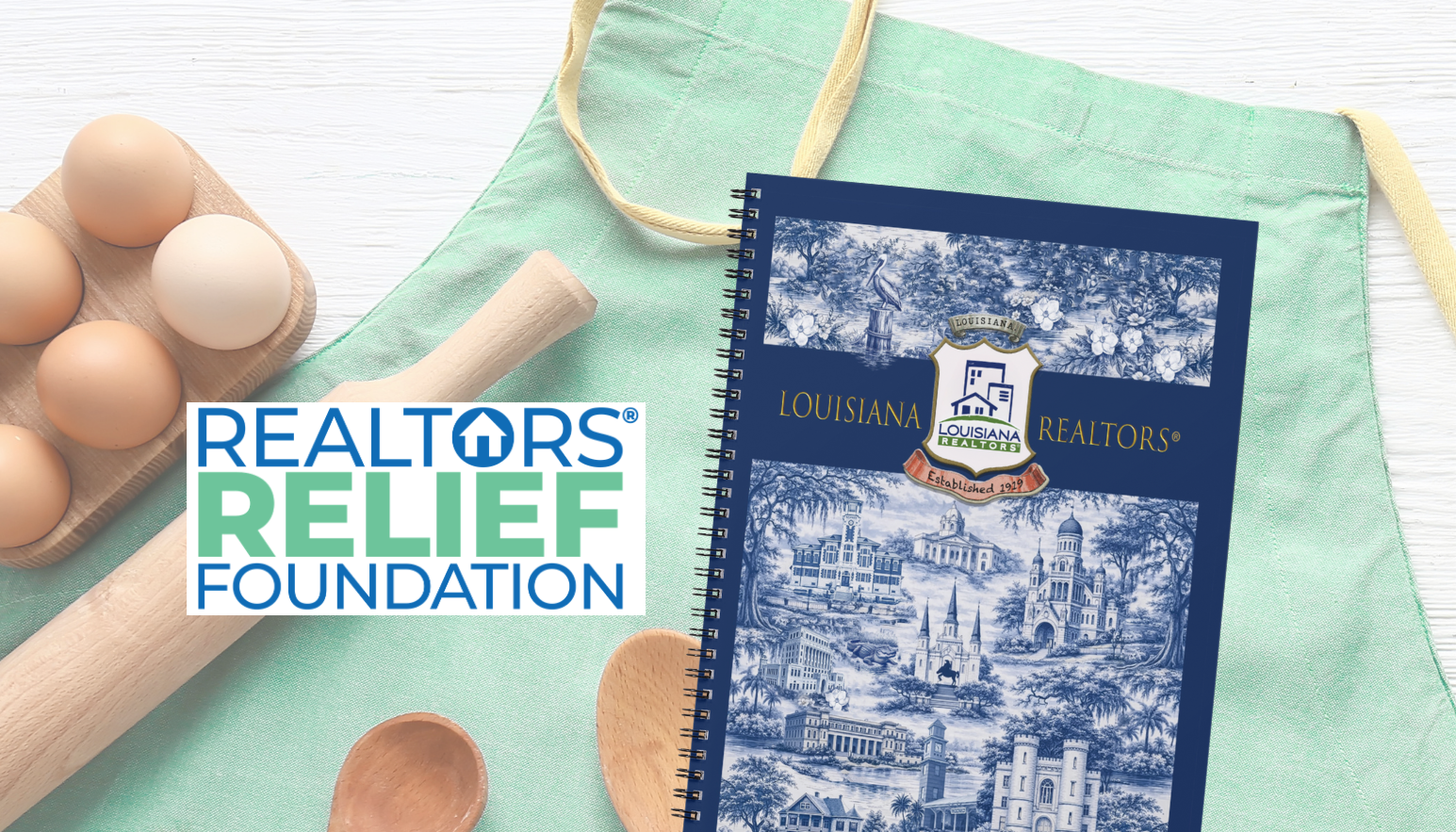
After months of gathering recipes from across our Louisiana REALTORS® family, the cookbook is ready! This 200+ page collection is filled with Louisiana flavor, REALTOR® heart and recipes contributed by our members. We launched sales of the cookbook at the Fall Governance Meetings. You can now purchase your copy for $30 directly from the printer and shipped to you! Additionally, we will have copies available at the RRF booth at NXT . After NXT, we will carry a limited stock at the LR office for you to purchase through the LR Merch Shop and pick-up from the office or at an LR event, as stock is available. Even better, $15 from every cookbook sold will be donated to the REALTORS® Relief Foundation (RRF) to help provide housing-related assistance to REALTORS® and their families following disasters. Pick up a copy for yourself, grab one as a gift and enjoy a taste of Louisiana while supporting a great cause!