
Legislative Session Ends With Less Fanfare
Written by Kim Callaway, Director of Legal & Governmental Affairs.
While previous sessions have ended with a bang and unfinished budgets, the 2019 Regular Legislative Session quietly ended Thursday, June 6 with a state budget passed with a few minutes to spare. This is likely because legislators who are term limited are tired from a very long twelve years and those who will be running this fall did not wish to rock the boat in an election year.
Overall, the session only had a few hotly contested issues and fortunately those few issues did not include real estate related bills. Louisiana REALTORS® will continue to advocate for legislation that benefits the real estate industry and property owners and to oppose legislation that would harm the real estate industry and property owners.
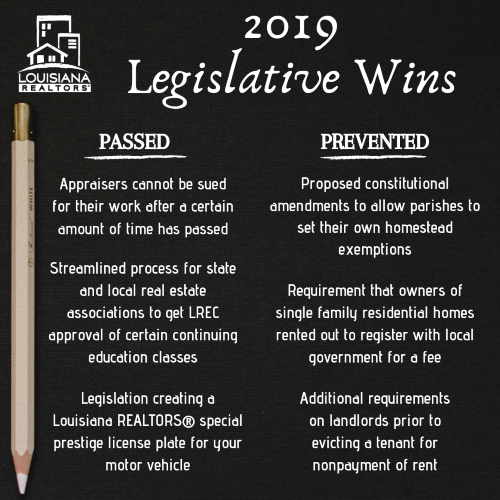
The following is a quick summary of legislation of interest to members of Louisiana REALTORS® with more detailed descriptions below:
Key items passed: Laws beneficial to the appraisers and a law to help real estate associations offer timely and interesting courses for you to attend to meet your continuing education requirements
Key items prevented: Attempts to allow local governments set homestead exemptions, a law to require owners of residential rental property to register the property with local governments for a fee, and a law to require a landlord wait longer to file to evict tenant for nonpayment of rent
Key items stalled: Changes to the date a real estate license is renewed, the extension of a tax credit for rehabilitation of nonresidential historic structures, authorization of remote online notarization
BUT HOW DOES THIS AFFECT YOU AS A REALTOR®?
Louisiana Real Estate Commission Related Bills
House Bill No. 299/Act 110, Representative Carmody
What: A continuing education vendor will be able to bypass the standard continuing education course approval process and instead go directly to the Executive Director of the Louisiana Real Estate Commission to request approval for the class to be offered for continuing education credit if the course is:
(1) A live course offered once a year in any one location and in conjunction with a conference, meeting, forum, or similar event held or sponsored by a state or local real estate trade association, or any affiliated Institute, Society, or Council.
(2) Offered to obtain certifications or designations awarded by the National Association of REALTORS® or its affiliated institutes, societies, and councils.
A state entity can also use this simplified process in seeking approval of any course it would like to offer to real estate licensees for continuing education approval.
Position: For
Status: Signed by the Governor; effective August 1, 2019
Why: The hope is that this fast track process will assist your state and local real estate associations in offering timely and interesting courses for you to attend to meet your continuing education requirements.
House Bill No. 353, Representative Emerson
What: This bill would have required a real estate licensee to renew his or her license with the Louisiana Real Estate Commission by October 31st. If a licensee failed to renew by that time, he or she would have had a delinquent renewal two months prior to the expiration period. This would have then allowed any licensee who failed to timely renew two months to remedy the delinquency without the license being expired.
Position: For
Status: The bill failed to pass in the House Committee on Commerce.
Why the Committee Did not Allow the Bill to Pass: The committee members questioned whether there would be adequate time to notify licensees of the change and the wisdom of requiring the renewal by October 31 rather than July 1st or by the licensee’s birthday as required in other professions and occupations.
Why Louisiana REALTORS® Supported the Bill: This would have allowed a real state licensee who failed to renew his or her real estate license with the Louisiana Real Estate Commission two months to remedy the delinquency without the license being expired. Louisiana REALTORS® supported this bill and will work with the Louisiana Real Estate Commission and legislators to find a solution to help the industry.
Appraisers
House Bill No. 340/Act No. 37, Representative Paul Hollis
What: This will allow an appraiser to perform an evaluation on property for a federally insured depository institution if federal law or rule permits them to do so.
Status: Signed by the Governor; effective August 1, 2019
Position: For
Why: The change will allow appraisers to perform services that they are currently prohibited from offering.
Senate Bill No. 191, Senator Norby Chabert
What: Proposes time limitations in which appraisers can be sued for their work. The limitation would not apply to any action filed prior to January 1, 2020 and the change would not be effective until January 1, 2020.
Status: Sent to the Governor
Position: For
Why: Louisiana REALTORS® is in favor of this bill because its passage would allow for appraisers to have some certainty that they will not be sued for their work after a certain period of time.
Homestead Exemption
The Louisiana State Constitution currently includes an exemption from state, parish, and special ad valorem property taxes for the bona fide homestead of a property owner for the first $7,500 of assessed valuation ($75,000 of the fair market value).
House Bill No. 12, Representative Steve Carter - DEFEATED
What: This was a constitutional amendment that would have allowed each parish to set their homestead exemption lower than the current homestead exemption.
Status: Failed to pass House Ways and Means Committee
Position: Against
Why: Louisiana REALTORS® believes that allowing each parish to set their own homestead exemption could lead to unpredictability for your clients and somewhat destabilize the real estate market.
if this bill had passed and voters approved the change in October, then each parish would then be able to vote to reduce their homestead exemption if the parish governing authority had put the issue on the ballot.
Buyers would not be able to predict their potential property tax bill with any certainty from year to year; therefore, potentially prohibiting them from purchasing a home or buying a smaller home to compensate for a possible spike in property taxes. The real estate market may not be stable unless buyers know when they are negotiating home purchases that the homestead exemption will remain the same for a long period in the parish where they are contemplating purchasing a home.
House Bill No. 439, Representative Barry Ivey - DEFEATED
What: This bill proposed a constitutional amendment that would have allowed each parish to adjust the amount of the homestead exemption – higher or lower than the current exemption - if the voters in the parish approved of doing so.
Status: Pending in House Ways and Means Committee
Position: Against
Why: The same reasons House Bill No. 12 is opposed.
HB No. 439 by Representative Ivey proposed a constitutional amendment that would have allowed each parish to adjust the amount of the homestead exemption if the voters in the parish approved of doing so. This bill was similar to House Bill No.12 but differed in that it would have allowed the homestead exemption to be set higher or lower in any parish.
Louisiana REALTORS® opposed this bill for the same reasons it opposed House Bill No. 12.
Rental and Landlord/Tenant
Senate Bill No. 218, Senator Barrow - DEFEATED
What: This bill originally was filed to create a mechanism to address private property owners who operate group homes for members of the population who may be vulnerable. The concept of the bill came about following the discovery of a group home in Baton Rouge where residents appeared to be severely neglected and showed signs of abuse.
However, the bill was amended in the Senate Committee on Health and Welfare to be a bill that would have required a property owner to register “a residential dwelling from which the property owner receives payment from the occupants in return for occupying or using the property” with local government.
The bill as amended in committee would have required each property owner to pay a registration fee of up to $500 (reduced by Senate Floor Amendment) to the local governing authority registering the property and if the owner failed to register the property then he or she would be assessed up to $150 per week (reduced by Senate Floor Amendment) by the local governing entity.
In effect, this bill would have required local governments to establish rental registries.
Position: Against with amendments
Status: Senator Barrow stated that she will not bring the bill back up on the Senate floor and would continue to study the issue of group homes in the interim.
Why: Louisiana REALTORS® opposed the amended bill for the following reasons:
· Thousands of good landlords should not be punished for the actions of those who do not properly maintain their property or value their tenants.
· A rental registry for all residential rental property would have been another layer of burdensome and unnecessary government overreach.
· This could have driven up rental rates resulting in fewer affordable housing units.
· The fees proposed by this bill were excessive.
Senate Bill No. 28, Senator Price - DEFEATED
What: With committee amendments, the bill would have mandated residential landlords whose tenants did not timely pay rent to wait five days to institute eviction proceedings.
Position : Against
Status : Failed to move out of Senate Committee on Judiciary A
Why : A mandated delay would have been onerous on landlords. Each day a rental property is vacant, or a nonpaying tenant is residing in the property is a day the landlord is not producing income from the property. This should be a contractual issue between a landlord and tenant.
Miscellaneous
House Bill No. 83, Representative Jimmy Harris
What: This bill would have extended the sunset of the tax credit for rehabilitation of nonresidential historic structures to January 1, 2026 . The tax credit for rehabilitation of nonresidential historic tax structures is now set to expire on January 1, 2022. An amendment was added on the House Floor that would limit the amount of tax credits awarded in a calendar year to $150 million and providing for the awarding of the tax credits on a first come, first-serve basis.
Status: Passed House, Pending Senate Finance
The bill did not pass due to the anticipated cost to the state. The extension cannot be filed in the 2020 Regular Legislative Session because of the constitutional restriction on legislating pertaining to tax matters in an even numbered year. However, a fiscal special session may be called in 2020 and if so, hopefully the credit will be extended then.
Position: For
Why: This program has helped preserve many historic buildings throughout Louisiana.
The use of tax credits encourages private sector rehabilitation of historic buildings and is one of the most successful and cost-effective community revitalization programs. These programs generate jobs and create commercial, residential, and industrial spaces within historic buildings.
House Bill No. 514, Representative Garofalo
What: This bill would have allowed for certain documents to be notarized remotely. Remote online notarization is when documents are notarized in an electronic form where the signer uses an electronic signature and appears before the notary using online audio-video technology.
Status: Reported out of House Committee on Civil Law and Procedure; was never heard on House floor
Position: For
Why: Remote online notarization is a tool which could modernize the sales transaction and allow for increased flexibility when it comes to closings. When implemented with appropriate safeguards to protect the privacy and security of consumers, online notarization results in a more accessible, streamlined, and verifiable way to have critical transactions notarized.
House Bill No. 317/Act No. 72, Representative Howard
What: Authorizes the creation of a Louisiana REALTORS® special prestige license plate
The bill will allow a special prestige license plate to be made available for members of Louisiana REALTORS®. All members will eventually be able to purchase the plate for their vehicle from the office of motor vehicles upon payment of their registration fee, an additional $10 annual fee that would benefit the Louisiana REALTORS® Relief Fund, and a $3.50 production fee. However, it will likely be a few years before the plate will be available as the office of motor vehicles is undergoing a complete renovation of their motor vehicle registration system.
Status: Signed by the Governor
Position : For
Why : Louisiana REALTORS® asked that this bill be filed so you can show your REALTOR® pride while also helping the Louisiana REALTORS® Relief Fund.
House Bill No. 372, “Omnibus Premium Reduction Act”, Representative Kirk Talbot
What: House Bill No. 372 would have changed laws that govern many aspects of personal injury lawsuits in the hopes that the changes would have led to lower auto insurance rates for Louisiana individuals, families and businesses.
Status: Failed to move out of Senate Committee on Judiciary A
In a recent survey of members of Louisiana REALTORS®, you told us that keeping up with technology was your biggest operational concern, but the top second and third concerns were the potential for litigation and insurance costs. If this bill would have become law, the hope was that your potential for litigation would be reduced and your insurance costs would have gone down.
The issue of “civil justice reform” and changing laws to lower insurance rates is sure to be a campaign issue in this fall’s elections.