
PAR Guide to Constitutional Amendments

Louisiana REALTORS • September 13, 2021

2021 Guide to Constitutional Amendments

The Public Affairs Research Council of Louisiana (PAR) has released the 2021 Guide to the Constitutional Amendments. Louisiana citizens have been coping with the effects of a surge in Covid cases and yet another terrible hurricane. As a result of the widespread damage from Hurricane Ida, fall election dates have been shifted. It is estimated that the storm has affected 42% of the state's registered voters.


October 9 election has been moved to November 13 

November 13 election has been moved to December 11


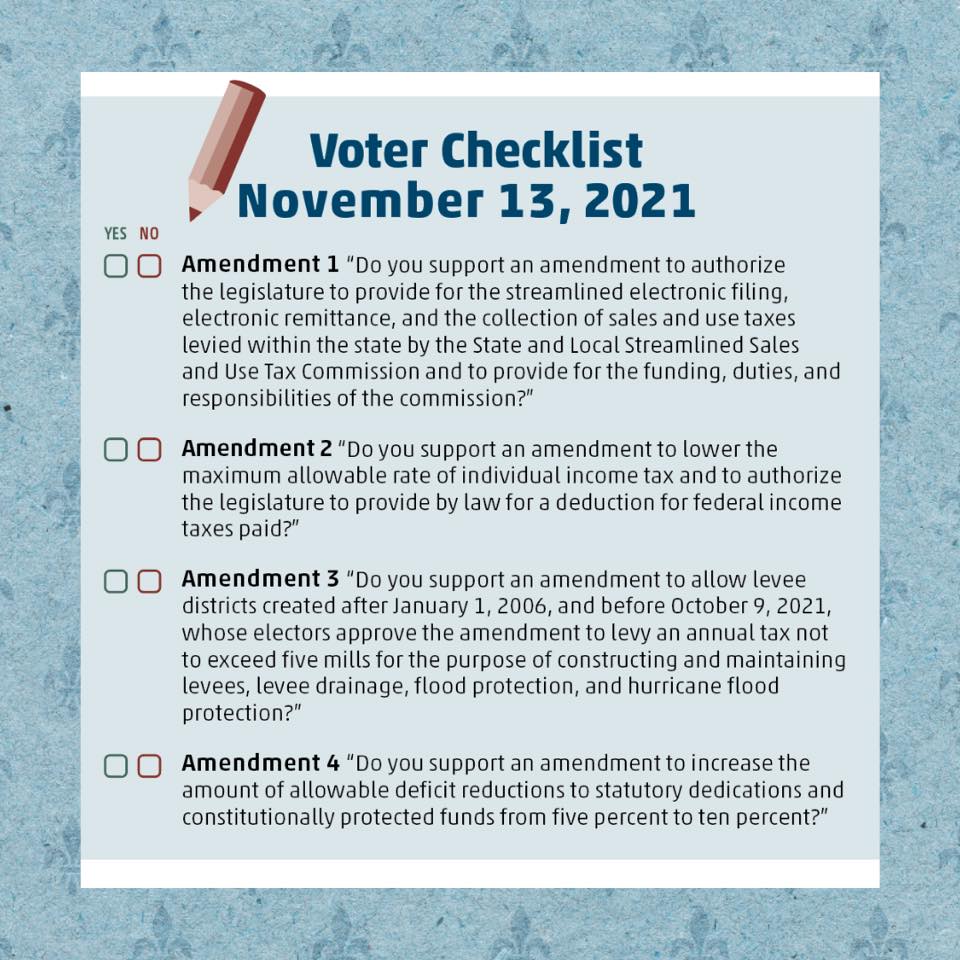
As an independent, nonpartisan educational organization, PAR has been providing reports on constitutional amendments set before voters over the past four decades. This PAR Guide to the 2021 Constitutional Amendments provides a review of each proposal in the order they will appear on the ballot. The Guide is educational and does not recommend how to vote. It offers succinct analysis and provides arguments of proponents and opponents. View the full guide here.
The Public Affairs Research Council of Louisiana (PAR) is an independent voice, offering solutions to public issues in Louisiana through accurate, objective research and focusing public attention on those solutions. PAR is a private, nonprofit research organization founded in 1950 and supported by membership contributions, foundation and corporate grants and special events.


By Louisiana REALTORS® • October 9, 2026
Homeownership Is on Louisiana's November Ballot
By Louisiana REALTORS® • October 8, 2026
After months of gathering recipes from across our Louisiana REALTORS® family, the cookbook is ready! This 200+ page collection is filled with Louisiana flavor, REALTOR® heart and recipes contributed by our members. We launched sales of the cookbook at the Fall Governance Meetings. You can now purchase your copy for $30 directly from the printer and shipped to you! Additionally, we will have copies available at the RRF booth at NXT . After NXT, we will carry a limited stock at the LR office for you to purchase through the LR Merch Shop and pick-up from the office or at an LR event, as stock is available. Even better, $15 from every cookbook sold will be donated to the REALTORS® Relief Foundation (RRF) to help provide housing-related assistance to REALTORS® and their families following disasters. Pick up a copy for yourself, grab one as a gift and enjoy a taste of Louisiana while supporting a great cause!
By Louisiana REALTORS® • October 7, 2026
A major change to residential appraisal reporting is approaching, but a recently announced temporary policy exception is creating some confusion about what happens on November 2. Here is what REALTORS® need to know. Beginning November 2, 2026, Fannie Mae and Freddie Mac will require the new Uniform Appraisal Dataset (UAD) 3.6 for new appraisal reports initially submitted to the Uniform Collateral Data Portal (UCDP), unless the lender has received a temporary policy exception. The November 2 implementation date has not been postponed. What is the UAD 3.6 Appraisal Report? UAD 3.6 replaces the familiar legacy appraisal forms (used for the last 25 years) with a new, more data-driven appraisal report that collects much more detailed property information. For REALTORS® and consumers, the transition could mean a more detailed property inspection, additional questions about the property and transaction, and potentially longer appraisal and review times as appraisers, lenders, appraisal management companies, and other industry participants adjust to the new system. What changed? Fannie Mae and Freddie Mac recently announced a temporary policy exception for eligible lenders that need additional time to complete their transition to UAD 3.6. Lenders receiving the exception may continue submitting appraisals using the current legacy UAD 2.6 format through May 19, 2027 . Beginning May 20, 2027 , new appraisal submissions to Fannie Mae and Freddie Mac must use UAD 3.6. What does this mean for REALTORS®? For several months, REALTORS® may encounter both the current appraisal format and the new UAD 3.6 appraisal report. The appraisal format is determined by the lender's assignment requirements. REALTORS® and consumers do not need to determine which format should be used. It is also important to understand that an appraiser completing a legacy-format appraisal during this period should not automatically be assumed to be unprepared for UAD 3.6. An appraiser who is fully UAD 3.6 ready may still be instructed by a lender to complete an assignment using the legacy format. How can REALTORS® help? Good communication and accurate property information will become even more important. REALTORS® can help the appraisal process by providing accurate and specific information concerning: Recent renovations and improvements Property features and amenities Sales concessions and financing terms Known property conditions or unique characteristics Relevant information about the transaction Buyers should also be encouraged to discuss appraisal requirements and anticipated timelines with their lender early in the transaction. What about FHA, VA and USDA? The November 2 requirement discussed above applies to Fannie Mae and Freddie Mac conventional lending. FHA, VA and USDA have their own appraisal policies and implementation schedules. Their transition to UAD 3.6 should not be assumed to follow the same November 2 timeline unless announced by the respective agency. The Bottom Line November 2 remains an important date for UAD 3.6. The temporary exception does not cancel or postpone the transition. Instead, it allows eligible lenders additional time to complete their transition. As a result, REALTORS® should expect a period when both legacy and UAD 3.6 appraisal reports are being used. Louisiana REALTORS® will continue monitoring the transition and providing members with updates as additional guidance becomes available. Louisiana REALTORS® is also planning a follow-up webinar to discuss the latest UAD 3.6 developments, what REALTORS® are seeing in transactions, and what these changes mean for agents and their clients.
Show More