Changes to NFIP Policies Coming Oct 1

Louisiana REALTORS • September 28, 2021

What REALTORS® Need to Know About Risk Rating 2.0

On October 1, 2021, FEMA will implement a new pricing system for National Flood Insurance Program (NFIP) policies called Risk Rating 2.0. This new pricing methodology comes just as the latest NFIP extension expires on September 30th . Expirations of NFIP extensions are something Louisiana citizens are all too familiar with, but the implementation of Risk Rating 2.0 will bring many changes to how NFIP flood policies are priced. 


Louisiana REALTORS® encourages REALTORS® and their clients to contact their insurance companies to determine what their new NFIP rates will be under Risk Rating 2.0. Many property owners are finding that their flood insurance rates will increase significantly under Risk Rating 2.0 while others are finding that their rates will remain relatively the same. Agents should also have discussions with their clients about sellers assigning their flood insurance policies to buyers so buyers can take advantage of any premium discounts a seller currently has (currently known as grandfathering). 


New NFIP policies, will be subject to the new pricing methodology. Existing policyholders eligible for renewal will be able to take advantage of any immediate decreases in their premiums. All remaining policies renewing on or after April 1, 2022, will be subject to the new pricing system.


REALTOR® members can be assured that Louisiana’s congressional delegation is leading the way to address both these matters. Senators Cassidy and Kennedy, along with other co-authors, introduced legislation to extend the NFIP program through September 30, 2022. And, Congressmen Scalise and Graves officially urged FEMA to delay the implementation of Risk Rating 2.0, however there has been no indication to date that Risk Rating 2.0 will be deferred. View the full letter here.


REALTORS® and their clients should reach out to their trusted insurance partners to learn how these changes will affect their individual NFIP policies so informed decisions can be made going forward. Addtional information about Risk Rating 2.0 can be found here.

Louisiana - Risk Rating 2.0

As part of an educational partnership with FEMA, Louisiana REALTORS® hosted a session "Flood Map Changes: What They Mean & What You Should Recommend" in August to highlight and explain the changes with addtional sessions scheduled throughout the remainder of the year. Panelists included Darrin Dutton, Rebecca Dake and Alan Johnson with FEMA Region 6 along with Pam Lightfoot with LADOTD Floodplain Office. 


Handouts and a full recording are available for further viewing along with additional information.

The National Association of REALTORS hosted a Town Hall meeting with FEMA Senior Executive David Maurstad providing an update on the new flood insurance pricing system of Risk Rating 2.0.

View the NAR Town Hall Recording

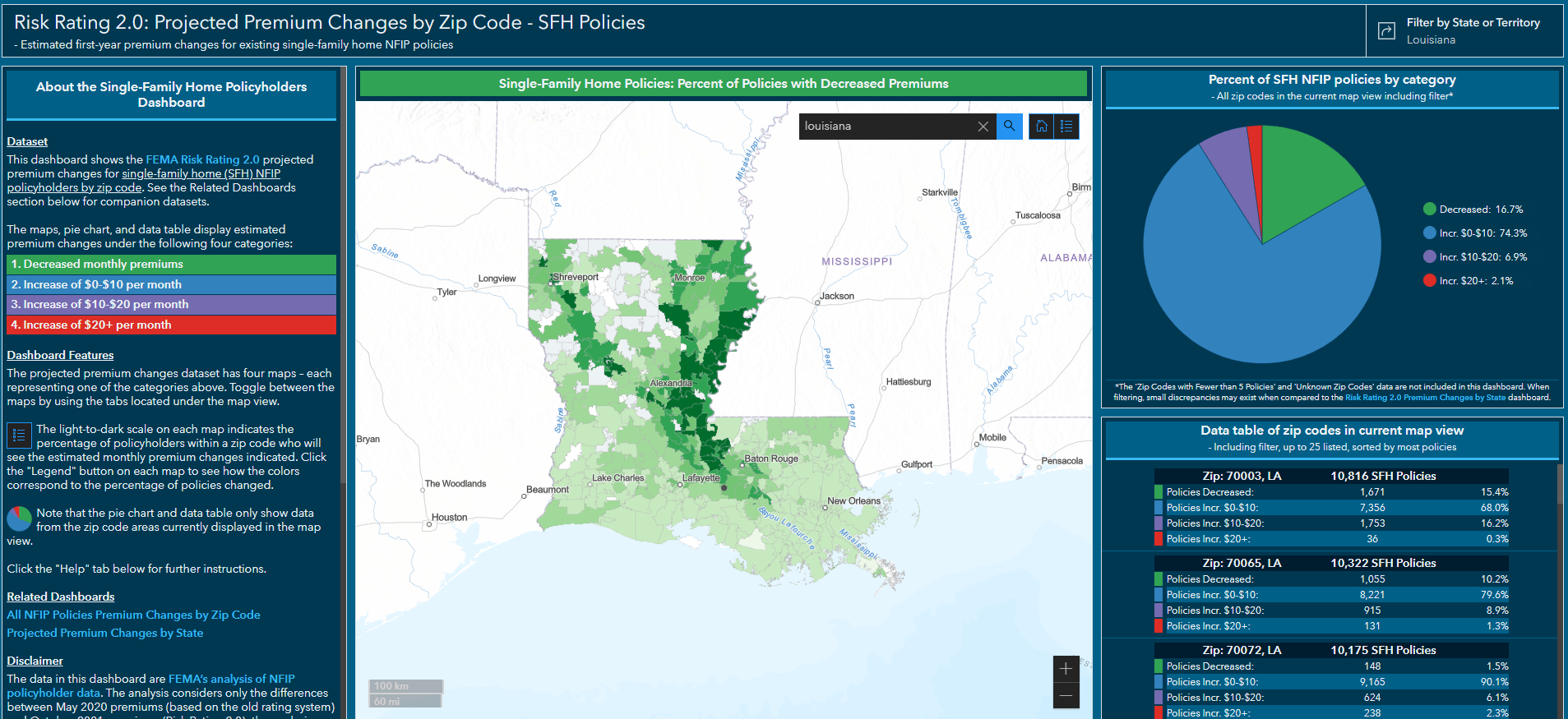
Risk Rating 2.0: Projected Premium Changes by Zip Code

This dashboard shows the FEMA Risk Rating 2.0 projected premium changes for single-family home (SFH) NFIP policyholders by zip code. The projected premium changes dataset has four maps – each representing one of the categories.

  • Decreased monthly premiums
  • Increase of $0-$10 per month
  • Increase of $10-$20 per month
  • Increased of $20+ per month

Disclaimer

The data in this dashboard are FEMA’s analysis of NFIP policyholder data. The analysis considers only the differences between May 2020 premiums (based on the old rating system) and October 2021 premiums (Risk Rating 2.0); the analysis does not consider typical premium increases that might have occurred without Risk Rating 2.0.


The maps generated do not reflect the total amount of premium changes or the overall cost of premiums paid. Nor do the maps provide information regarding any property’s unique flood risk. In compliance with data privacy policies, data in zip codes with less than five policyholders have not been released by FEMA. The number of policies and associated rate changes across all of these areas are available only in the aggregate



By Louisiana REALTORS® April 3, 2026
This week, the Legislature remained in high gear, and several items relevant to Louisiana’s real estate market moved into focus. The biggest headline for our industry this week was HB 468 by Rep. Troy Hebert , our wholesaling/consumer-protection bill, was slated to be heard on the House floor, however was bumped due to floor congestion and out-of-order bills. It is now expected to be reset for next Tuesday. This bill remains one of the clearest “market integrity” efforts on the board with clearer rules for non-traditional transactions, stronger transparency and better consumer protections. We also continued substantive policy work behind the scenes. We are actively engaging with Rep. Carver on a vacant land disclosure bill he has authored, and we appreciate that he is welcoming our input and guidance as the language is refined. Our goal is straightforward: ensure any vacant land disclosure framework is practical, reduces confusion and avoids unintentionally shifting liability or enforcement burdens onto real estate professionals. In addition, we were pleased to deepen our relationships at the Capitol this week. We had the privilege of hosting a lunch for the Governor’s Office, enjoyed meeting Governor Landry’s team, and look forward to working with them in a constructive, solutions-oriented manner as the session continues. Finally, Rep. Hebert also filed an additional measure that aligns with our legislative agenda and speaks directly to transaction risk management: HB 1027 , which would limit liability for licensed real estate appraisers in situations involving smoke and carbon monoxide detector compliance. The current law already provides that real estate agents are not liable for a seller’s failure to comply with Louisiana’s detector requirements in one- or two-family dwellings. HB 1027 would extend that same liability protection to licensed appraisers by amending R.S. 40:1581(F). This is a clean, common-sense clarification that helps prevent appraisers from being pulled into compliance disputes that properly belong with the seller’s statutory obligations. Next week, committees are scheduled to hear multiple bills relevant to real estate, including measures involving construction and roofing standards (often tied to insurance and mitigation), property rights/expropriation, and property tax and adjudicated property issues that can influence housing supply and neighborhood reinvestment. We will stay closely engaged and will flag any bills or amendments that materially affect transactions, homeownership costs or private property rights. Please view the weekly bill tracking report provided by our lobbying team over at Harris, DeVille and Associates.
By Louisiana REALTORS® April 2, 2026
Louisiana REALTORS® is compiling a cookbook of Louisiana flavor with a REALTOR® heart in support of the REALTORS® Relief Foundation . And we have two ways for you to get involved:  Join us in contributing your favorite recipe using this online form. If you want to include a picture with your recipe, send to info@larealtors.org and reference recipe title in email subject. Or share your creativity by designing the cover artwork for the cookbook. A small committee will review all entries and choose one to print on the cover. Stay tuned for more details on when you can grab your own copy of the cookbook! Cover artwork and recipes are due by April 17th.
By Louisiana REALTORS® March 27, 2026
Week three of the Regular Session kept real estate issues in the conversation, even as lawmakers continued to focus heavily on workforce, tax and insurance policy. On the property tax front, measures to reshape assessments and exemptions, including proposals for a new blight rehabilitation exemption and additional relief for seniors, remain parked in the House Ways and Means Committee as stakeholders work through fiscal and local government concerns. These bills matter because they will influence long-term carrying costs, redevelopment incentives and how tax burdens are shared across residential and commercial property. Homestead related legislation, including parish level authority to increase the exemption amount, is also in the queue, signaling that the broader structure of Louisiana’s homestead system is officially on the table, not just the dollar figure. For homeowners and buyers, this debate goes directly to affordability. For local governments, it raises revenue stability and service delivery questions. There also has been movement on several identical pieces of legislation that would instruct parish assessors to develop a process for homeowners to permanently register for the homestead exemption for the duration that they own and live on the property. We are actively tracking legislation that will directly shape how investor activity and non-traditional transactions are recognized and regulated in Louisiana’s real estate market. This includes HB 468 by Troy Hebert , a key component of the Louisiana REALTORS® legislative package that targets the wholesale of residential real estate, which was heard in the House Commerce Committee on Monday. The bill is currently positioned for a floor vote early next week. As drafted, HB 468 represents a major step in the right direction for consumer protection in Louisiana, advancing needed guardrails through potential disclosure, registration, and practice standards that could redefine how assignment contracts and “off-market” transactions intersect with licensed brokerage activity. In parallel, HB 292 by Delisha Boyd passed the House on final reading, 86-3, and is on its way to the Senate. Together, these measures represent a coordinated policy effort to bring greater structure and transparency to emerging transaction models, while preserving the integrity of the traditional brokerage framework. Finally, the broader policy backdrop remains important: the Governor continues to push income tax changes and cost of living relief, while business and industry groups are prioritizing insurance, workforce and energy — each a key driver of long run housing demand and investment. As these debates evolve, we’ll keep you updated on what moves, what stalls and what it all means for your clients, your pipeline and private property rights across Louisiana. Please view the weekly bill tracking report provided by our lobbying team over at Harris, DeVille and Associates.
Show More